Focus on liquidity and yield in early 2Q21

Webinar-On-Demand

During the first week of April benchmark US equity indexes climbed to new record highs, the IMF forecast full year growth of 6.4% for the world’s largest economy — which added over 900,000 jobs in March – and US Federal Reserve officials reiterated their commitment to highly accommodative monetary policy.

Against this backdrop, mutual fund investors headed in opposite directions. EPFR-tracked US Money Market Funds took in fresh money for the eighth time in the past nine weeks, a run that has seen these liquidity vehicles pull in over $170 billion, while flows to Emerging Markets and High Yield Bond Funds during the first week of the second quarter hit eight and 41-week highs respectively.

Investors not stretching for yield or going liquid stuck with established reflationary and inflationary themes or looked to cut costs. Through the week ending April 7, Equity Funds with global mandates have posted inflows every week year-to-date, as have equity and bond funds with socially responsible (SRI) or environmental, social and governance (ESG) mandates. Meanwhile Inflation Protected Bond Funds have absorbed fresh money for 21 straight weeks and Bank Loan Funds, traditionally used to play rising short-term interest rates, for 14 consecutive weeks.

On the cost cutting front, there has been growing interest in Collective Investment Trusts (CITs). Like ETFs and mutual funds, CITs are pooled investment vehicles, but are not regulated by the SEC and have cost structures akin to separately managed accounts. EPFR’s coverage of CIT assets has grown fourfold over the past three years to over $850 billion, and in % of AUM terms these vehicles have been more popular with investors than ETFs or mutual funds.
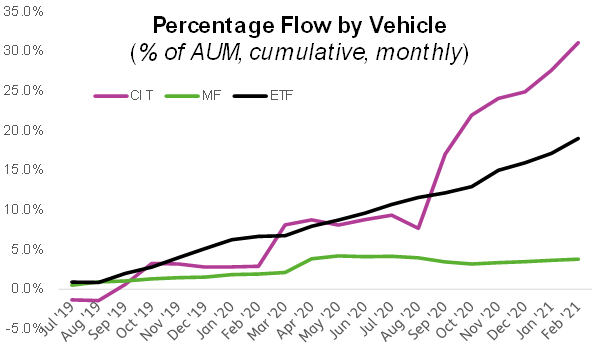
Graph depicting the 'Percentage flow by vehicle, as percentage of Assets under management, cumulative monthly, from July 2019 to February 2021'.

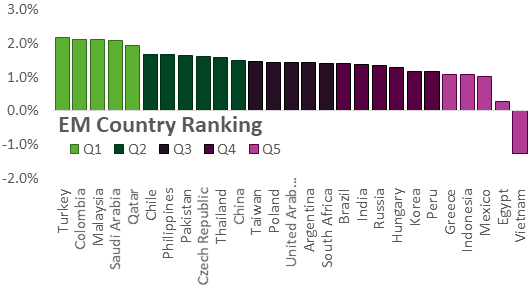
Graph depicting the 'Emerging markets country ranking, from Q1 to Q5'.

Did you find this useful? Get our EPFR Insights delivered to your inbox.
Related Posts

Still buying into the ceasefire as April winds down

Still buying into the ceasefire as April winds down

April ended with another week of record highs for key equity indexes, oil prices holding around $100 a barrel, first quarter earnings reports pouring in and a slew of major central bank policy meetings. Against this backdrop, investors continued to rebuild their positions in riskier asset classes and boost their exposure to US stocks while cutting their leverage and their exposure to Europe.

Some optimism eludes the blockade in mid-April

Some optimism eludes the blockade in mid-April

The market euphoria that followed the announcement of a ceasefire between the US and Iran on April 7 soon ran into the painful reality that both sides remain far apart. But, despite the US blockade of the Straits of Hormuz, its momentum lifted benchmark US equity indexes to fresh record high and continued to drive a “risk on” rotation in the flows to and from EPFR-tracked fund groups.

Risk appetite reemerges as de-escalation hopes drive fresh inflows

Risk appetite reemerges as de-escalation hopes drive fresh inflows

For the second time in a row, the reporting period for EPFR-tracked funds ended with markets responding to hopes of an end to the fighting between the US and Iran and the accompanying energy shock. The upshot was a marked increase in risk appetite, which was reflected in the latest flow data. High Yield Bond Funds posted their first inflow since mid-February, flows into Private Credit Funds hit an eight-week high, and investors steered fresh money into Europe Equity, Bond and Money Market Funds.

Better, More Actionable Insights

Let us show you how EPFR can create value for your specific strategy